Shipped
APP/WEB
B2B SaaS
Timeline
My Role
Team
Tool
Overview
Paywork is a business document management platform for small business owners in Korea, many of whom are in their 50s and 60s. Users can create and manage essential business documents in one place, including estimates, transaction statements, and tax invoices.
To access Paywork’s core paid features, including tax invoice issuance, users first had to complete business authentication. However, many users dropped off during this required step and never reached the product’s paid value. This project focused on helping more users complete authentication by reducing its biggest source of friction, manually entering business information. We introduced OCR to automate data entry, making it easier for users to complete authentication and reach Paywork’s paid features.
Key Objectives
Amplitude analysis revealed an overall authentication completion rate of just 41.4%.
The largest losses came at the two manual input steps, which required nine fields in total. The steepest single drop, 31.4%, happened at the business information step. Six of the nine fields (business name, registration number, representative name, address, business type, and category) were already printed on the business registration certificate users had in hand.
User interviews confirmed what the funnel suggested. Re-entering information they already had was the main reason they gave up.


Strategy
The goal was to eliminate manual re-entry entirely.
Round 1. Third-party business registry API (Rejected)
We first explored an API that auto-fills fields from a registration number alone.
Testing revealed two blockers. Sole proprietor data, the majority of Paywork's user base, came back incomplete because the API relied on credit lookup systems. And every query was billed whether the data came back complete or not, which meant paying per lookup for mostly empty results at scale.
We ruled it out.

Round 2. OCR (Selected)
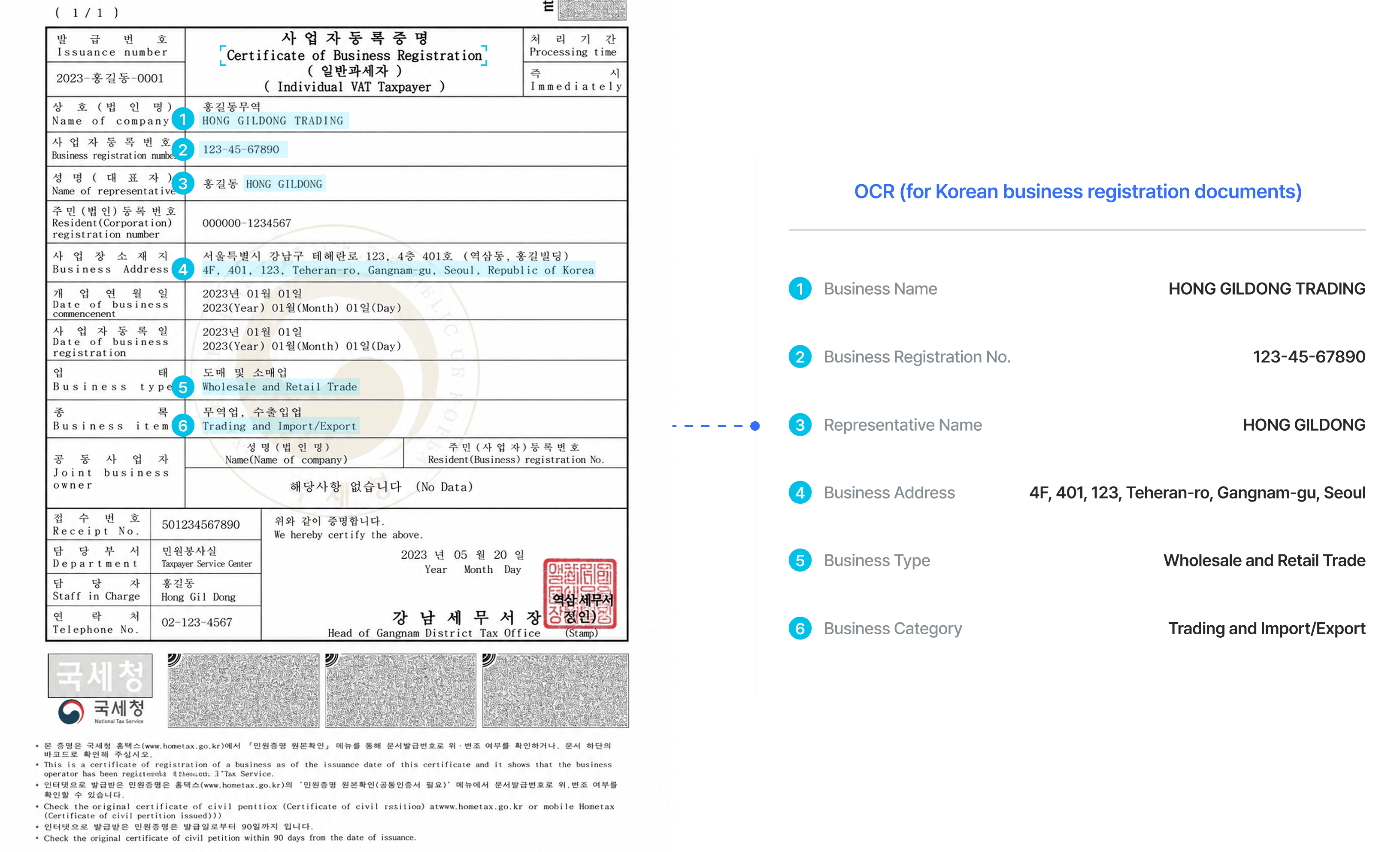
Design Solution

Impact
Paywork's core users are small business owners in their 50s and 60s who needed to send invoices quickly.
For this group, having to manually type critical business information was not just friction, it was a real barrier before they could use any paid feature. By introducing OCR to remove that barrier, we saw the following results.
52%
increase in verification completion rate
5x
Takeaways