Summary

Generative Al can significantly enhance software automation testing by providing tools for writing and understanding test automation code, generating test cases, and maintaining test scripts. It utilizes Large Language Models (LLMs) to create automated test code, test plans, and scenarios while simplifying the testing process. Various Al-driven tools are available to assist in these tasks, allowing testers to focus on application functionality rather than coding intricacies.

A new course on Udemy explores the use of Generative Al in software automation testing.

# AI

# Generative AI

# Business

9:41

AI-recommended folders.

Moving a link will create a new folder.

AI

Classified Links: 12

Move All

Step-by-Step Introduction to Figjam AI for Better Design Colla….

Summary

It introduces features like generating boards and diagrams through text prompts, sorting and summarizing sticky notes, and offers tips.

# FigJam

# AI

# Design

Design

1 days ago

Move to AI Folder

Consulting 5.0: Rethinking the Traditional Consulting Model in the


Summary

Simon introduces the concept of "Consulting 5.0," which integrates AI and Web3 to create a more equitable, transparent, and impactful consulting landscape. This new model aims to empower clients with instant access to world-class expertise at fair prices, moving beyond traditional frameworks to address the complexities of today's digital environment.

# AI

# Web3

# Tech

Uncategorized

3 days ago

Move to AI Folder

Beyond the Hype: When Generative AI Isn’t Always the Answer


Summary

While generative AI has gained significant attention, it may not always be the most effective solution. The author emphasizes the importance of evaluating specific business needs and considering alternative AI approaches, such as predictive AI, which might be more suitable in certain contexts.

# Generative AI

# Predictive

# Business Solutions

Business

17 days ago

Move to AI Folder

9:41

AI Classification

All

32

12

Wellbeing

12

Tech

3

Design

5

In Search of Improving Database Performance: A Comprehensive Guide with 8 Key Strategie

To improve database performance, the article outlines eight essential strategies. First, optimizing indexing can boost query speeds

# Database

# AI Integration

# OpenAI

Tech

3 days ago

More Performance + AI Integration | Azure Database for MySQL — Flexible Server

It highlights improvements in scalability and cost-efficiency, particularly with the new Accelerated Logs feature, which redirects transaction logs to

# Accelerated Logs

# Scale

# Business

AI

23 days ago

What is Data?

The article defines data as collections of facts and values, and a database as an organized electronic storage of this data managed by a Database Management System (DBMS). It also briefly introduces types of databases, including relational, NoSQL, cloud, and distributed databases.


# Data

# DBMS

# Data Management

Tech

31 days ago

Database Developer: What It Is, What They Do, & Salary


A database developer is a software engineer specializing in designing, building, testing, and maintaining databases. They create relational database management systems (RDBMS) to store and manage data efficiently. Their responsibilities include ensuring data security, keeping information up-to-date, and identifying trends to enhance database performance.


# Optimization

# Query

# Security

Tech

31 days ago

9:41

All 4

Tech 3

AI 1

Database

Home

Search

Storage

Linkit: AI-Powered Link Management

Linkit: AI-Powered Link Management

How I designed AI summaries and content-based search to help users revisit what they saved

How I designed AI summaries and content-based search to help users revisit what they saved

Launched in App Store

AI

Case Study

Timeline

Mar 2024 - Oct 2024

(25 Weeks)

My Role

Led user research
Designed AI summary flow
Created end-to-end mobile UI

Led user research
Designed AI summary flow
Created end-to-end mobile UI

Team

2 Product Designers (Minjee, Jaeyon)

3 iOS Developers

3 Android Developers

4 Node Developers

2 Product Designers (Minjee, Jaeyon)

3 iOS Developers

3 Android Developers

4 Node Developers

Outcome

MVP Launched

2nd Place at Mash-Up Demo Day

Background

People save useful links every day, from articles and videos to tools and references.

But saving does not always lead to revisiting. Over time, saved links become difficult to understand, organize, and find again.

Research

Survey Findings

A 160-person survey revealed that users were saving links frequently, but struggling to find and understand them later.

64%

had trouble remembering

what saved links were about.

26%

specifically struggled with

search-based retrieval.

The issue wasn't saving itself.

Users needed better context, organization, and retrieval.

Interview Findings

To understand why saved links were difficult to retrieve,

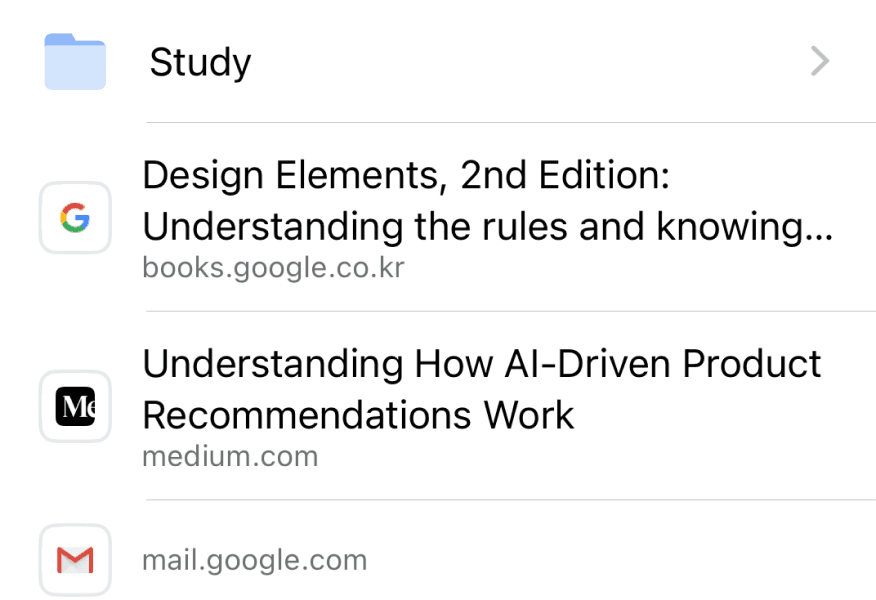
I conducted 5 one-on-one interviews with users who saved links through browser bookmarks.

Q. Find a saved link from your bookmarks.

Q. Find a saved link from

your bookmarks.

“It's hard to determine if the link I'm looking for matches the title, so I have to open each link individually to check.”

Office worker in their 20s

Problem 1

Titles and thumbnails were not enough.

Users had to reopen multiple links to confirm what each one was about.

Users remembered topics,

but results depended on exact titles or saved text.

Q. Why is it hard to organize saved links?

Q. Why is it hard to organize

saved links?

“If a link is important, I categorize it by type,

but it's too cumbersome to organize every link I save.”

Office worker in their 30s
Problem 2

Manual organization felt tedious.

Users wanted structure, but folders and notes required too much effort.

Users wanted structure, but folders and notes required too much effort.

PM

Mission

Strategy

Analytics

No serach results found

Q. Search for a recently saved link.

Link the interviewee was looking for

Interviewee's search keywords

"I couldn’t remember the content title, so I searched with keywords I remembered, but often couldn’t find what I needed."

20s job seeker

Problem 3

Search required exact keywords.

Users remembered topics, but results depended on exact titles or saved text.

Users remembered topics, but results depended on exact titles or saved text.

From Insights to Design Direction

Each finding shaped one core product direction for Linkit.

Direction 1

Help users understand saved links

at a glance.

Direction 1

Help users understand saved links at a glance.

Direction 1

Help users understand saved links

at a glance.

AI summaries and keywords provide context without requiring users to reopen every link.

Direction 2

Reduce the effort of organizing

saved links.

Direction 2

Reduce the effort of organizing saved links.

Direction 2

Reduce the effort of organizing

saved links.

AI recommends folders and categories based on link content, reducing manual sorting.

Direction 3

Make retrieval possible through meaning, not exact titles.

Direction 3

Make retrieval possible through meaning, not exact titles.

Content-based search helps users find saved links using remembered topics, keywords, or intent.

Design Solution

Feature 01 · AI Summary

Summarize link content and keywords automatically.

Understand every saved link

before reopening it

Summarize link content and keywords automatically.

Problem

Users often saved links quickly, then returned later to titles that no longer felt clear.

Design Decision

When a user pastes a link, Linkit reads the linked post and generates a short summary and keywords.

Instead of making users open the original page to understand the content, we brought the key information into the save flow.

Result

Users could quickly understand what a link was about without reopening it, using the AI-generated summary and keywords.

Feature 02 · AI Categorization

Organize existing links without manual sorting.

Organize knowledge automatically,

without manual sorting

Problem

Manual folders and notes required too much effort to maintain.

Design Decision

We designed AI-powered category recommendations for links that were uncategorized or poorly organized.

Instead of asking users to sort each link one by one, Linkit groups related links together and lets users review the suggested organization.

Result

This reduced manual sorting while keeping saved links easy to browse by category.

Feature 03 · Content-based Search

Search beyond titles

Search beyond titles

Problem

Users remembered topics or keywords, but search results often depended on exact titles.

Design Decision

We expanded the search beyond exact titles by using AI-generated summaries and keywords.


Instead of relying only on title matching, Linkit searches across the content signals users are more likely to remember, such as keywords and summarized topics.

Result

Users could find saved links based on what the content was about, not just the exact title they had saved.

Launch & Recognition

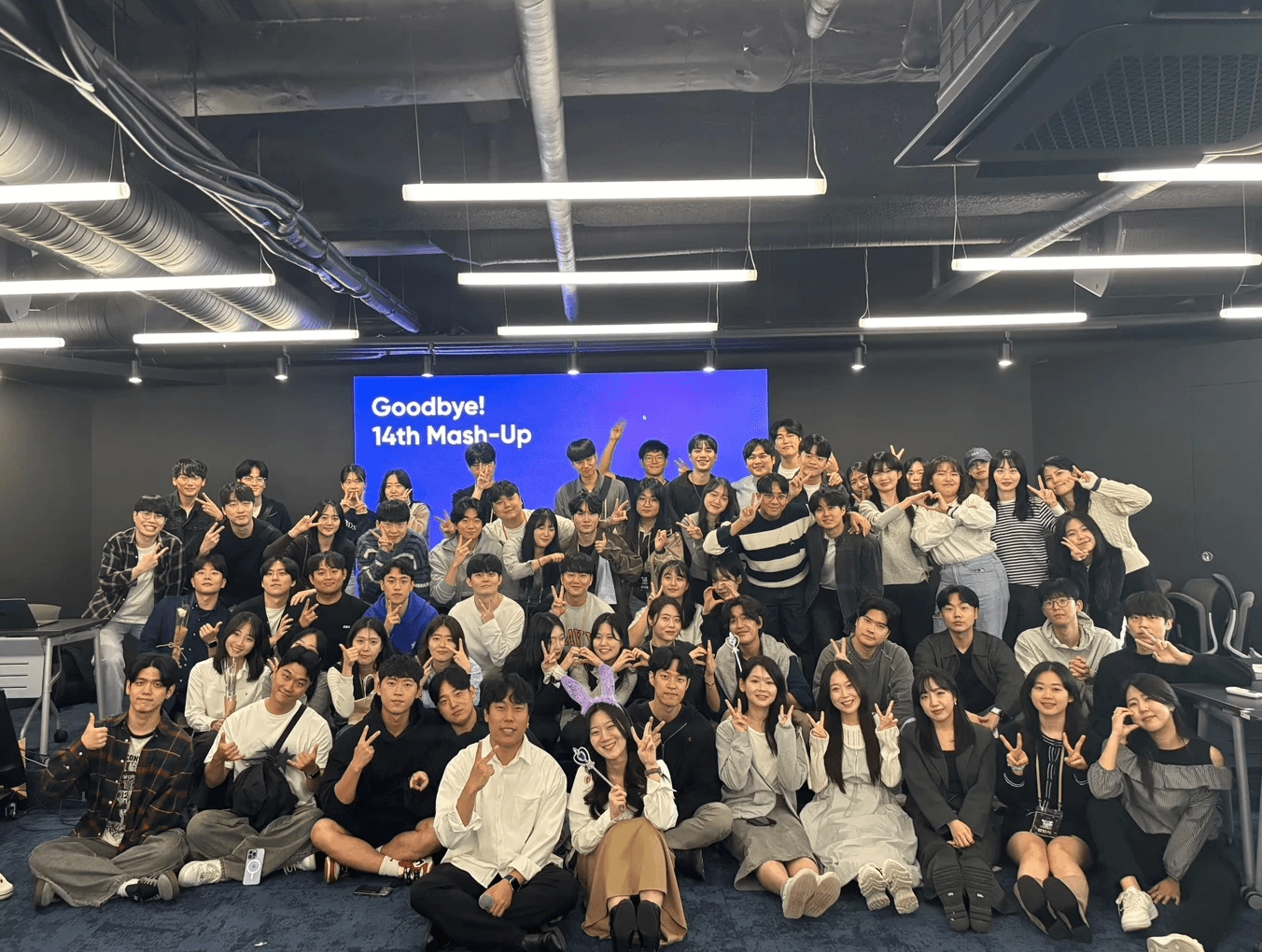
MVP Launch · 2nd Place at Demo Day

Linkit was built and launched as an MVP through Mash-Up, a product-building community of 100+ designers and developers.

Our team presented the product at Mash-Up Demo Day and won 2nd Place among participating teams.


As an MVP built within a time-limited program, we did not yet have long-term usage data. If we continued the project, I would track return visits, category acceptance rate, and how often users reopened saved links after using AI summaries.

Reflection

What I learned

Launch day feedback showed that AI recommendations are only trusted when users can see the reasoning behind them. A feature can work technically and still fail if users don't understand why the system made a given choice.

What I would improve

Some users felt the AI-recommended categories did not match the way they personally organized information.

With more time, I would let users adjust category suggestions based on their own habits and measure whether that increased return visits and long-term retention.

Some users felt the AI-recommended categories did not match the way they personally organized information.

With more time, I would let users adjust category suggestions based on their own habits and measure whether that increased return visits and long-term retention.

THANK YOU
FOR VIEWING

THANK YOU
FOR VIEWING

THANK YOU
FOR VIEWING